SOA OS23: Modern Evolution of Intelligent Service-Oriented Architecture
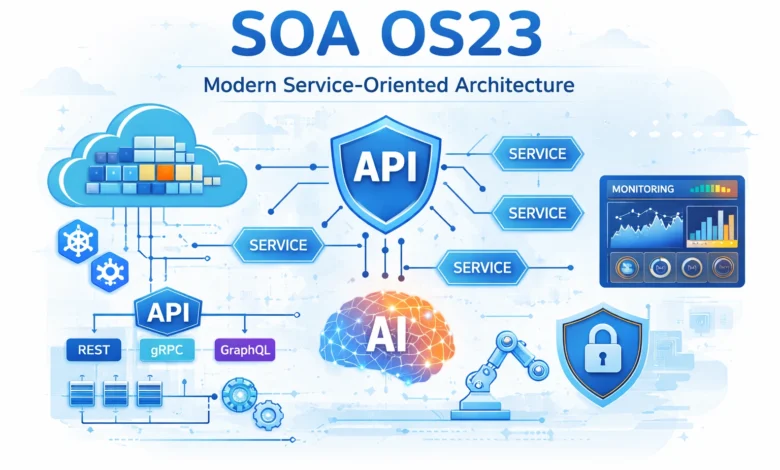
SOA OS23 represents a powerful and modern evolution of Service-Oriented Architecture (SOA), designed to meet the demands of today’s highly dynamic, cloud-driven, and data-intensive digital ecosystems. While traditional SOA focused on modularity and enterprise integration, SOA OS23 reflects a more mature, adaptive, and intelligent architectural mindset. It integrates classical SOA principles with modern innovations such as cloud-native deployment, microservices alignment, API-first design, event-driven communication, and AI-assisted operations.
In an era where scalability, resilience, and rapid adaptability are essential, SOA OS23 provides a robust framework for building systems that are not only technically efficient but also strategically aligned with evolving business needs.
Quick Bio:
| Attribute | Details |
|---|---|
| Architecture Type | Evolved Service-Oriented Architecture |
| Core Focus | Scalability, interoperability, intelligence |
| Design Style | Cloud-native, API-first, loosely coupled |
| Communication | REST, events, asynchronous messaging |
| Deployment | Containers and orchestration platforms |
| Governance | Automated, policy-driven |
| Intelligence Level | AI-assisted monitoring and optimization |
| Primary Use | Enterprise-scale distributed systems |
Understanding the Foundations of SOA
Service-Oriented Architecture is built on the idea of structuring software systems as a collection of independent, reusable services that communicate through standardized interfaces. Each service represents a distinct business capability and can be developed, deployed, and maintained independently.
The original goal of SOA was to reduce system rigidity, promote reuse, and enable seamless integration across heterogeneous platforms. However, as systems grew larger and more distributed, traditional SOA models faced challenges related to scalability, performance, and operational complexity.
SOA OS23 emerges as a response to these limitations.
What Defines SOA OS23?
SOA OS23 is not a replacement for SOA—it is its evolutionary refinement. It modernizes SOA by adapting it to contemporary computing environments while preserving its foundational principles.
Key defining traits include:
-
Cloud-native deployment readiness
-
Alignment with microservices thinking
-
API-centric communication
-
Event-driven interaction models
-
Built-in security and governance
-
Intelligent automation and observability
Architectural Characteristics of SOA OS23
Cloud-Native Orientation
SOA OS23 is designed to operate seamlessly in cloud environments. Services are deployed in lightweight containers and managed through orchestration systems that support elastic scaling, high availability, and fault tolerance. This allows systems to dynamically respond to workload changes without manual intervention.
Microservices Alignment
While traditional SOA often used coarse-grained services, SOA OS23 adopts finer-grained, domain-focused services similar to microservices. Each service owns its logic and data, enabling independent deployment and faster innovation cycles.
Rather than being contradictory, microservices are best understood as a specialized expression of SOA principles within OS23.
API-First and Contract-Driven Design
In SOA OS23, APIs are treated as first-class assets. Services expose well-defined contracts that ensure consistency, versioning, and backward compatibility. API gateways manage routing, security, traffic control, and monitoring, simplifying client interaction and enhancing system reliability.
Event-Driven Communication
Modern distributed systems require responsiveness and scalability. SOA OS23 embraces asynchronous, event-driven communication models that decouple services and allow real-time data propagation. This approach improves performance and reduces dependency bottlenecks.
Security and Governance in SOA OS23
Security in SOA OS23 is embedded by design, not added as an afterthought. Zero-trust principles ensure that every service interaction is authenticated, authorized, and encrypted. Identity-based access control and automated policy enforcement provide consistent security across the system.
Governance has also evolved. Instead of rigid centralized control, SOA OS23 implements adaptive governance, combining decentralized ownership with automated compliance checks and global standards.
Intelligence and Automation
A defining strength of SOA OS23 is its integration of intelligent automation. AI-driven mechanisms enable:
-
Predictive scaling of services
-
Anomaly detection and fault prediction
-
Automated recovery and self-healing
-
Intelligent routing and load balancing
These capabilities significantly reduce operational overhead while improving system resilience.
Benefits of SOA OS23
SOA OS23 offers numerous advantages:
-
Enhanced scalability and flexibility
-
Faster development and deployment cycles
-
Improved fault isolation and resilience
-
Seamless integration of legacy and modern systems
-
Better alignment between business processes and IT systems
-
Reduced long-term maintenance costs
Challenges and Considerations
Despite its strengths, SOA OS23 introduces certain challenges:
-
Increased architectural and operational complexity
-
Greater reliance on automation and monitoring tools
-
Network latency considerations
-
Requirement for skilled DevOps and cloud expertise
Successful adoption requires careful planning, proper tooling, and strong architectural governance.
Practical Applications of SOA OS23
SOA OS23 is widely applicable across domains, including:
-
Enterprise digital transformation initiatives
-
Cloud migration and modernization projects
-
Financial and e-governance systems
-
Smart manufacturing and industrial automation
-
IoT and real-time analytics platforms
-
AI-driven decision support systems
Conclusion
SOA OS23 represents a powerful, intelligent, and future-ready evolution of Service-Oriented Architecture. By combining classical SOA principles with cloud-native technologies, microservices alignment, API-first design, and AI-assisted operations, it delivers a scalable and resilient architectural framework for modern enterprises. SOA OS23 is not merely a technical upgrade it is a strategic enabler for building adaptive, secure, and high-performance digital systems in an increasingly complex technological landscape.
FAQs
What does SOA OS23 stand for?
SOA OS23 refers to the modern evolution of Service-Oriented Architecture, emphasizing cloud-native design, intelligence, and adaptability.
Is SOA OS23 the same as microservices?
No. Microservices are a specialized implementation approach within the broader SOA OS23 paradigm.
Why is SOA OS23 important today?
It addresses scalability, resilience, and integration challenges faced by modern distributed systems.
Can SOA OS23 integrate legacy systems?
Yes. One of its strengths is seamless integration between legacy and modern platforms.
Does SOA OS23 require cloud deployment?
While optimized for cloud environments, its principles can be adapted to hybrid and on-premise systems.